Two good circulators, one big difference
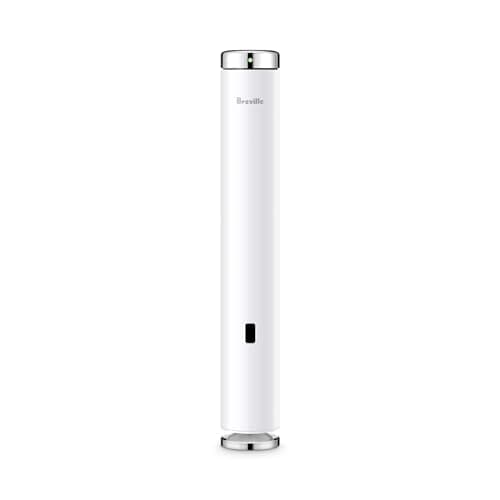
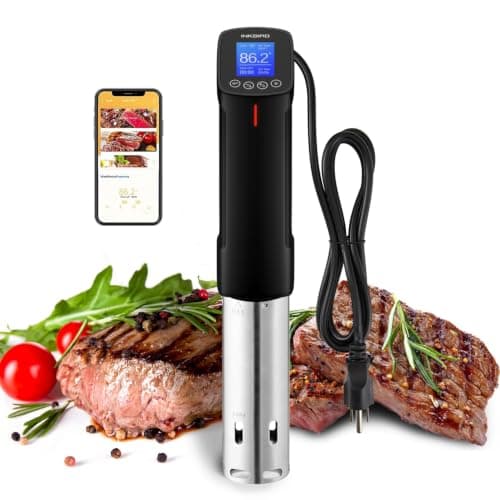
These two are both genuinely worth owning, which is what makes the choice interesting: it is not about quality, it is about how you want to interact with the machine and how much you want to spend. The Inkbird ISV-100Wis the value pick that does not feel like one — a full specification and an on-device screen for under $100. The Breville Joule Turbois the premium object — the smallest, best-built circulator here, with a magnetic foot and a Turbo mode — but it is app-only, with no screen and no buttons. For most people the Inkbird is the smarter buy; the Joule is the right answer for a particular kind of cook, and we will say exactly who.
The Inkbird case: a full spec sheet under $100
The Inkbird's whole argument is that it hands you the numbers. On its own product page it publishes the complete specification — 1,000 W, a 25–99°C (77–210°F) range, ±0.1°C accuracy and a 15 L water capacity — at a price where most rivals publish almost nothing. That ±0.1°C accuracy figure matters, because it is the number that defines a precision cooker, and on paper it matches the far pricier Anova for less than half the money. It also gives you both an on-device dot-matrix screen and WiFi, so it works fully at the machine and lets you start or check a cook from your phone when you want to. The honest trades are real but small: a one-year warranty, a merely-functional app, and 2.4 GHz WiFi only.
The Joule case: the smallest, best-built, best app
The Joule answers with things the Inkbird cannot match. It is the most compact circulator on this site, small enough to drop in a drawer, with a magnetic foot that lets it stand in a steel pan without a clamp and IPX7 waterproofing. It draws 1,100 W, works in a vessel up to 10 gallons, and its Turbo modegenuinely shortens some cooks. And for a beginner, Breville's app is the best teaching tool in the category — a visual doneness guide that shows you what a given temperature does to the food before you commit. On build and polish it feels a clear tier above its rivals. If you already live in your phone and want the nicest object, the Joule is a delight to use.
The documentation gap that separates them
Here is the split that decides it for a lot of buyers. The Inkbird publishes a temperature range and a ±0.1°C accuracy figure; Breville publishes neitherfor the Joule on any manual we could find. For a device whose entire job is holding an exact temperature, that is a real gap — not evidence the Joule's control is loose, but an absence where a number should be, and it is exactly the kind of thing our Documentation metric scores. When one machine tells you precisely what it does and the other asks you to trust that it is good, the one that tells you has earned something. The Inkbird wins this outright.
Screen versus app: the everyday difference
This is the part you will feel every single cook. The Inkbird has an on-device screen, so a dead phone or an app outage does not stop you cooking — you set temperature and time on the machine itself. The Joule has no screen and no buttons at all; the app is the only interface, full stop. For someone who is happy running everything from a phone, that is a shrug and the app is lovely. For anyone who resents cooking being gated behind a login, a firmware update or a low battery, it is a friction they will hit repeatedly. There is no middle setting here: you either do not mind an app-only machine or you actively do, and if you are unsure, that uncertainty is itself a reason to take the machine with the screen.
Price, power and warranty
On raw power the Joule's 1,100 W edges the Inkbird's 1,000 W, so it heats a large bath a touch faster, but for the portion sizes home cooks actually do the difference is immaterial — both are genuinely powerful. Both carry a one-year warranty, so warranty is a wash between these two (it is the Anova, at two years, that leads there). Price is where they part decisively: the Inkbird sits under $100, and the Joule is the premium tier. You are paying the Joule premium for size, build, the magnetic foot and Turbo — not for better temperature control on paper, since Breville does not publish the numbers that would let you compare it.
The decision rule
Buy the Inkbirdif you want the most sensible circulator for the money: a full published spec, ±0.1°C accuracy, an on-device screen so it works without a phone, and WiFi when you want it — all for under $100. It is the right pick for most people, full stop. Buy the Jouleif you specifically want the smallest, best-built machine, you love the idea of Turbo mode and the app's visual doneness guide, and a phone-only interface genuinely suits how you cook. If you are on the fence, the Inkbird is the safer default; the Joule is a want, not a need. See where each lands in the best WiFi sous vide machines.
How we picked
Machines we claim to have tested: 0
Everyone in this category tells you they tested twenty cookers. We have tested none, and we say so. Here is what we do instead: read the manufacturer's manual and spec page, record the published wattage, capacity, pressure or temperature figure and warranty term, work out what the machine costs to run per hour, show the arithmetic so you can redo it with your own electricity rate, and cite all of it. Where a brand publishes no wattage, we print no running cost rather than borrowing a number from a similar model. Prices come live from Amazon's API and disappear rather than go stale.
The scores above are judgments from that documented research — not test results. One of the five metrics is Documentation: whether the manufacturer will tell you what its cooker draws at all. The full rubric, including what disqualifies a pick, is published in full.