HUB 02 · Rice Cookers
What size rice cooker should I buy?
Rice-cooker sizing has two traps in it. The 'cup' on the box is 180 ml, not a US cup, and it is measured with raw short-grain rice - so the number means less rice than you think and varies by grain. And a cooker has a minimum useful batch as well as a maximum, which is why the biggest machine is the wrong answer for a small household.
We earn a commission if you buy through our links. It does not change the price you pay, and it does not decide our picks — the scoring rubric is published in full, including what disqualifies a pick. How this works.
The short answer
Size the cooker by how many rice cups you cook in one meal, then add one. For one person that is a 3-cup machine, for two it is 3 to 4 cups, for a family of four it is 5.5 cups, and for five or more, or for anyone batch-cooking, it is 6 cups and up. Those numbers are smaller than they sound, for two reasons that the box does not explain: the “cup” is 180 mlrather than a 240 ml US cup, and the rating describes uncooked rice, which roughly doubles in the pot.
The mistake worth avoiding is buying up “to be safe.” A rice cooker has a smallest batch it cooks well as surely as it has a largest, so an oversized machine is not a neutral choice — it is a worse cooker for the batches you will actually make, in a bigger footprint, for more money.
Trap one: the cup is 180 ml, and it is measured with short-grain rice
A rice cooker cup is the traditional Japanese gō— 180 milliliters, roughly three-quarters of a US cup — and the little plastic cup in the box is that measure, not a kitchen cup. We have a whole page on why that matters, because the water lines inside the inner pot are calibrated to it and everything drifts if you measure with the wrong cup.
For sizing there is a second half to it that almost nobody mentions. Zojirushi states on its own product pages that capacity is measured using a 180 ml rice measuring cup with raw short grain white rice, and that other grains may vary. So a “5.5-cup” cooker is 5.5 cups of short-grain japonica. Long grains behave differently in the same pot: basmati in particular expands far more than short-grain rice does, so a pot rated at 5.5 short-grain cups holds fewer basmati cups before it is uncomfortably full. If your household eats mostly long-grain rice, read the rating as an optimistic number rather than a hard one — and see the best rice cookers for basmati for the machines that handle it best.
Trap two: capacity has a floor, not just a ceiling
Every rice-cooker sizing guide tells you not to exceed the maximum. Far fewer mention that the bottom of the range is a real constraint too, and it is the reason “buy bigger, you can always cook less” is bad advice.
A rice cooker works by sensing what the contents are doing — temperature at the base, and in a fuzzy-logic machine a model of how the cook should be progressing. One cup of rice in a wide 6-cup pot spreads into a thin layer with a lot of headroom above it, which is a different thermal problem from the one the machine was tuned for: the water boils away faster relative to the mass of rice, and the cooker has less to sense. The inner pot's lowest water line is the manufacturer telling you where its calibration starts. Below it, you are off the map.
You can see the manufacturers acknowledging this in the one place they are forced to be specific. Aroma's own manual for the 4-cup ARC-994SG caps simultaneous steaming at 2 cups of uncooked rice — a published limit, in a 4-cup machine, because what is physically possible and what the cooker is calibrated for are not the same thing. Treat roughly one-third of rated capacity as the practical floor: a 3-cup cooker is happy with one cup, a 6-cup cooker is not.
The arithmetic, done once
One rice cooker cup of uncooked rice is 180 ml dry and comes out at roughly double that cooked. The manufacturers publish this where they bother to: Cuckoo rates the CRP-P0609S as 6 cups uncooked / 12 cups cooked, and Aroma rates the ARC-994SG as 4 cups uncooked / 8 cups cooked. Two published one-to-two ratios, from two different makers, in two different countries.
A normal side portion of cooked rice is around one cup; a main-course portion where rice carries the plate is closer to one and a half to two. So one uncooked rice cup feeds about two people as a side, or one as a main. Our how much rice per person page works the portions through properly.
| Household | Uncooked cups per meal | Cooked volume | Cooker to buy | In this catalog |
|---|---|---|---|---|
| One person | 1 | About 2 cups | 3-cup | Toshiba mini, 3 cups uncooked |
| Two people | 1 to 1.5 | 2 to 3 cups | 3 to 4-cup | Toshiba mini or Aroma ARC-994SG |
| Three to four | 2 to 3 | 4 to 6 cups | 5.5-cup | Zojirushi NW-QAC10, NS-ZCC10, NS-TSC10; Tiger JAX-T10U |
| Five or more, or batch cooking | 3 to 5 | 6 to 10 cups | 6-cup and up | Cuckoo CRP-P0609S or CR-0631F, 6 cups uncooked |
| Rice as a main course, not a side | Roughly double the cups-per-meal figure above, then size from the new number | |||
Note where this catalog stops: the largest cooker we cover is 6 cups uncooked. Ten- and twenty-cup machines exist and are the right answer for a very large household or a caterer; we do not cover them, and this page is not going to pretend otherwise. Our large rice-cooker roundup ranks the top of the range we do cover.
Three cases where the arithmetic is not the answer
You keep rice warm all day.Then buy for the batch, not the day, and resist sizing up to cover both. Keep Warm is a holding function, not storage — how long it is safe to leave rice in a rice cooker covers why, and the answer involves Bacillus cereus rather than taste. Cooking a 3-cup batch twice beats cooking a 6-cup batch and holding half of it for nine hours.
You batch-cook for the freezer. Here, and only here, size up aggressively: a full pot cooked once and portioned immediately is the one use case where the largest machine genuinely earns its footprint. The meal-prep roundup is built around that argument.
Counter space is the binding constraint.A rice cooker that lives in a cupboard gets used half as often as one that lives on the counter, and footprint is the specification almost nobody publishes. Zojirushi is the exception in this catalog — it prints 9‑1/4 x 12‑1/4 x 7‑7/8 inches for the NW-QAC10, which is a genuinely small 5.5-cup machine. Where a maker publishes no dimensions we do not estimate them; the small rice-cooker roundup ranks the field on footprint with the same discipline, and the small-kitchen guide handles the cross-category version of the problem.
Does size change the rice quality?
Not directly, and this is worth saying because it is where the sizing question usually gets confused with the quality question. A 3-cup cooker is not inherently worse at cooking rice than a 6-cup one. What correlates is the feature set: the smallest machines tend to be cheaper machines, and cheap machines are more likely to run a fixed timer instead of adjusting heat through the cook. The Toshiba mini is the useful counter-example in this catalog — a 3-cup cooker with fuzzy logic, which is the combination most small cookers do not offer.
So treat capacity and heat control as two separate decisions. Settle the size from the table above, then pick the mechanism: what fuzzy logic actually does is the place to start, and induction versus fuzzy logic covers the step above it. If you want the whole decision in one page, how to choose a rice cooker runs through every criterion in order, and the main roundup is where the ranked picks live.
One last cross-check if you already own a multicooker: it probably makes acceptable rice, and whether you need a second appliance at all is a fair question. Do you need a rice cooker if you have an Instant Pot answers it honestly, and what size Instant Pot to buy is this page's multicooker counterpart if you decide to go that way instead.
The hardware
The cookers this page is about
The cookers referred to above, with prices pulled live from Amazon and dated on every card. Full rankings live in the roundups linked from this page.
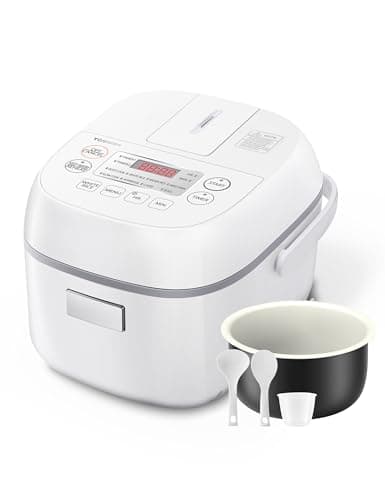
Wattage not published
Toshiba Mini Rice Cooker, 3 Cups Uncooked, with Fuzzy Logic
A small fuzzy-logic cooker for one or two people — the rare compact rice cooker that still senses and adjusts rather than running a dumb timer. Three cups uncooked, one-touch operation, and a 24-hour delay so rice is ready when you get home.
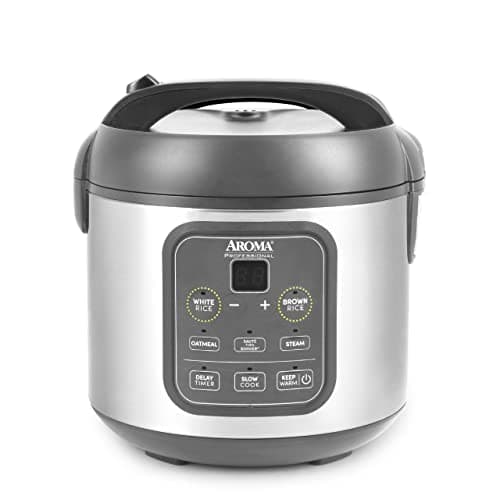
450 W
Aroma Professional ARC-994SG Digital Rice Cooker & Multicooker
The budget pick now, and an honest one. For around forty dollars it cooks white and brown rice, sautés then simmers, slow-cooks for 2 to 10 hours and steams — a genuine little multicooker in a small pot — and Aroma publishes its 450 W draw. What Aroma does not publish is how its 'Sensor Logic' works, and there are only two rice programs, so this is the versatility pick, not the rice-quality one.
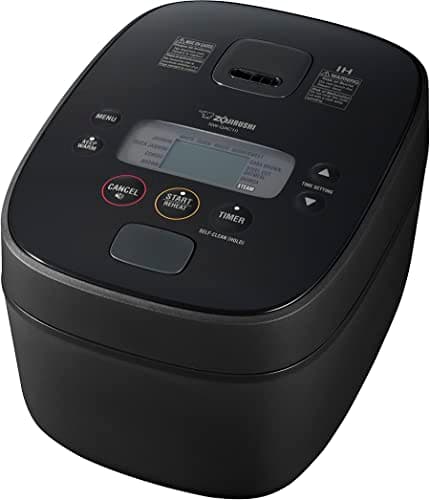
1,080 W
Zojirushi NW-QAC10 Induction Rice Cooker & Warmer, 5.5 Cup
Zojirushi's in-stock 5.5-cup induction cooker, and the one we now point daily rice eaters at. Whole-pot induction heating, made in Japan, in a flat-top body that is smaller than the NP-HCC10 it replaces and draws 1,080 W rather than 1,230. The trade is documentation: Zojirushi does not publish a triple heater for this one, and the pan is nonstick-coated rather than left unstated.
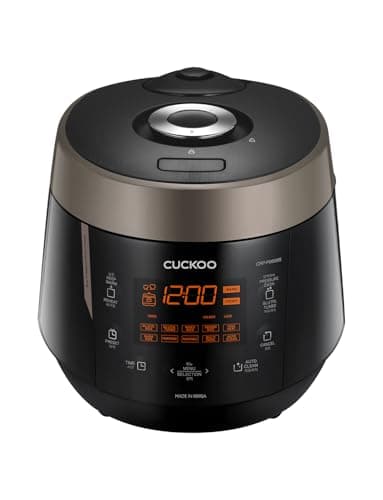
890 W
Cuckoo CRP-P0609S High-Pressure Rice Cooker, 6 Cup
A pressurized rice cooker, which is the Korean approach and a genuinely different one: cooking rice under pressure raises the boiling point and produces a distinctly fluffier, stickier grain, especially for short-grain and mixed rice. 890 W, a 304 stainless pot, and Cuckoo's signature talking interface.
#ad · As an Amazon Associate we earn from qualifying purchases.
Questions
Frequently asked
What size rice cooker do I need for a family of 4?
What size rice cooker is best for 1 or 2 people?
Is a rice cooker cup the same as a measuring cup?
Does a rice cooker's rated capacity mean cooked or uncooked rice?
Can you cook a small amount of rice in a big rice cooker?
Should I buy a bigger rice cooker than I need, just in case?
Does the type of rice change what size I need?
What is the largest rice cooker you cover?
Keep reading
Related
- What is a rice cooker cup?The 180 ml measure the whole rating depends on.
- How much rice per personPortions worked through, which is the input to the sizing table.
- The best small rice cookersRanked picks for one or two people, on footprint.
- The best large rice cookersThe other end of the range, for five or more.
Receipts
Sources
- Zojirushi — NW-QAC10 Induction Rice Cooker & Warmer product page (features & specifications)
- Zojirushi — NS-ZCC10 Neuro Fuzzy Rice Cooker product page
- Cuckoo America — CRP-P0609S pressure rice cooker product page
- Aroma Housewares — ARC-994SG instruction manual [PDF]
- Amazon listing (manufacturer-supplied copy) — Toshiba mini capacity
We have not tested these machines in a lab and we do not pretend to have. Specifications come from the manufacturer's own published documents; electricity rates come from the US Energy Information Administration; prices come from the live Amazon API. Where a figure is not published, the page says “not published” rather than guessing. Read the full method.