HUB 03 · Sous Vide
Immersion circulator vs sous vide
This is a vocabulary problem that costs people money. Sous vide is a cooking method; an immersion circulator is one kind of appliance for doing it. Shops sell both words as if they were rival products, which is how buyers end up comparing a technique with a motor.
We earn a commission if you buy through our links. It does not change the price you pay, and it does not decide our picks — the scoring rubric is published in full, including what disqualifies a pick. How this works.
The short answer
They are not alternatives, and nothing is being compared. Sous vide— French for “under vacuum” — is a cooking method: you seal food, put it in water held at exactly the temperature you want the food to end up at, and leave it until it gets there. An immersion circulator is a device for doing that: a stick you clamp to a pot, containing a heating element, a temperature sensor and a pump that moves the water so the whole bath stays at one temperature. Almost every home sous vide machine sold today is an immersion circulator, so if a listing says one and you wanted the other, you are looking at the right thing. The distinction only matters in two situations, and both are below.
The method, in one paragraph
Conventional cooking applies heat far hotter than the food should end up — a 450 °F oven for a 130 °F steak — and you pull the food out when the middle happens to arrive. The outside is always more cooked than the inside, and the window is small. Sous vide inverts that: the water is held at 130 °F, so the food cannot go past 130 °F no matter how long it sits. The edge-to-edge result is uniform, and the timing becomes a range rather than a moment. That is the whole idea, and what sous vide is covers it in full.
Two practical consequences follow. There is no browning, because nothing in the bag gets anywhere near searing temperature — so almost everything is finished in a hot pan afterwards, and whether to sear before or after is its own question. And the method is time-and-temperature food safety rather than hit-a-number food safety, which is why the safety pageleans on the USDA's pasteurization guidance rather than on a single minimum temperature.
The three machines that do it
| Device | How it works | The trade |
|---|---|---|
| Immersion circulator | A stick clamped to any pot you own. Element, sensor and pump in one body; the pump keeps the whole bath at one temperature | None worth mentioning. You supply the vessel, which is also why it stores in a drawer |
| Water oven (a self-contained bath) | A countertop tub with its own lid and element, usually no pump — it relies on even heating rather than circulation | Fixed capacity, large to store, and without a pump the bath can stratify. Quieter, and nothing to clamp |
| A multicooker's sous vide program | The cooker's own element holding a still pot of water at a set point, with no pump at all | Loosest control of the three. Fine for eggs and chicken breast, poor for anything where a degree matters |
The pump is the whole reason the circulator won. Water left alone stratifies — warmer at the top, cooler at the bottom, and cooler again right against a bag of cold meat. Moving the water means the number on the display is the number everywhere in the pot, which is what makes the method's central promise true. A multicooker's sous vide setting has no pump, which is why we are consistently lukewarm about it; the do you need a sous vide if you have an Instant Pot page is where that is argued out.
Does “under vacuum” mean you need a vacuum sealer?
No, and this is the other place the vocabulary misleads. The name describes how restaurants did it, not what the physics requires. What you actually need is for the water to be in contact with the food rather than with a jacket of trapped air, because air insulates. A zip-top bag lowered slowly into the water so the pressure pushes the air out — the water displacement method — achieves that perfectly well for a steak or a chicken breast. Sous vide without a vacuum sealer covers the technique, whether Ziploc bags are safe covers the bag question, and keeping the bag from floating covers the one failure mode that actually ruins a cook.
What to look for in a circulator, in order
Wattage first, because it decides how fast the bath comes up and how well it recovers when you drop cold food in. The circulators we cover run 850 W to 1,100 W, and the gap shows on a big container rather than a small pot. Published temperature range and accuracy second.This is a precision device, so a manufacturer that will not state its accuracy is telling you something — Anova publishes ±0.1 °C and a 0–92 °C range; Inkbird publishes ±0.1 °C and 25–99 °C; Breville publishes no temperature range or accuracy figure for the Joule in any manual we could find, which for a precision cooker is a real documentation gap. Pump flow third— Anova publishes 8 L/min on the full-size model, 7 L/min on the Nano — which matters if you cook big batches in a deep container. Then the interface. A screen on the device means it works when your phone does not; the Joule is app-only by design, with no buttons at all.
What is not on that list is a feature count. Every circulator does the same single thing, so the differences are the four specs above plus warranty length — and the full decision, with the arithmetic, is on how to choose a sous vide machine.
When the distinction genuinely matters
First, if you are shopping for a self-contained water oven.Those exist, they are a real category, and they are a different purchase — fixed capacity, their own lid, nothing to clamp, usually no pump. Searching “sous vide machine” returns both kinds mixed together, and the word “circulator” is the one that filters for the stick. We do not rank water ovens here; every machine in this catalog is a circulator.
Second, if someone is selling you an “immersion heater”.A heater without a pump or a controller is not a circulator and will not hold a temperature — it is the thing a bucket of water gets warmed with. The word “circulator” specifically means the pump is in there, and the pump is what makes the bath uniform.
So what should you actually buy?
A circulator, almost certainly — and the three below are the ones we would point you at. The Anova Precision Cooker 3.0is the default: 1,100 W, ±0.1 °C, an 8 L/min pump, an on-device screen so it works without the app, and a two-year warranty, the longest here. The Inkbird ISV-100Wpublishes the same ±0.1 °C accuracy at 1,000 W with WiFi and a screen for well under half the money, and gives up a year of warranty and some polish. The Breville Joule Turbo is the smallest and best-built, with a magnetic foot and IPX7 waterproofing, and it is app-only — no screen, no buttons — which is either the point or a dealbreaker.
If you would rather see the whole field ranked, the best sous vide machines and the best immersion circulators are the two roundups — the same field, filed under both words, for exactly the reason this page exists. If the budget is the constraint, the budget picks start lower, and if you have not decided whether the method is for you, is sous vide worth it is the honest version of that question.
The hardware
The cookers this page is about
The cookers referred to above, with prices pulled live from Amazon and dated on every card. Full rankings live in the roundups linked from this page.
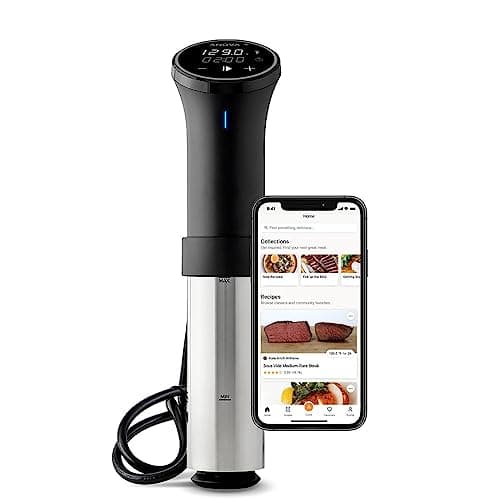
1,100 W
Anova Precision Cooker 3.0 (WiFi), 1100 W
The sous vide circulator most people should buy. Anova publishes the full specification — 1,100 W, a 0–92°C range, ±0.1°C accuracy, an 8 L/min pump — and backs it with a two-year warranty, the longest here. It has an on-device screen so it works without the app, which the Joule does not.
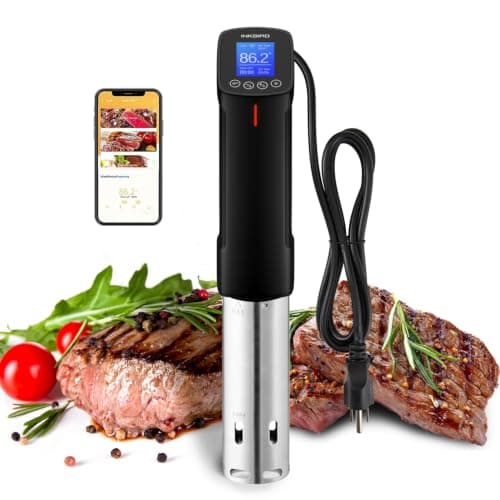
1,000 W
Inkbird ISV-100W WiFi Sous Vide, 1000 W
The value pick that does not feel like one. Under $100, and Inkbird still publishes the full specification: 1,000 W, a 25–99°C range, ±0.1°C accuracy, 15 L capacity, WiFi and an on-device dot-matrix screen. It undercuts the Anova by more than half and gives up remarkably little on paper.
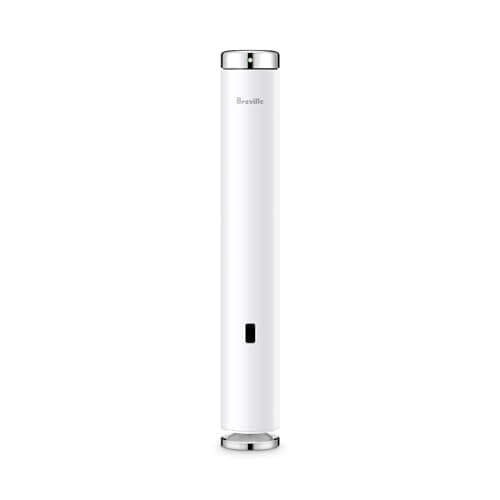
1,100 W
Breville Joule Turbo Sous Vide (BSV600), 1100 W
The smallest, cleverest and most divisive circulator here. It is app-only — there are no buttons and no screen, so your phone is the interface, full stop. In return you get the most compact body, a magnetic foot, IPX7 waterproofing, and a Turbo mode Breville claims can halve the time. 1,100 W.
#ad · As an Amazon Associate we earn from qualifying purchases.
Questions
Frequently asked
Is an immersion circulator the same as a sous vide machine?
What is the difference between an immersion circulator and a water oven?
Why does an immersion circulator need a pump?
Do you need a vacuum sealer for sous vide?
Is an immersion heater the same thing?
Which specs matter when buying a circulator?
Keep reading
Related
Receipts
Sources
- Anova Culinary — Precision Cooker 3.0 product page
- Inkbird — ISV-100W WiFi Sous Vide product page
- Breville — Joule (BSV600) safety guide [PDF]
- USDA FSIS — cooking safely with time and temperature (pasteurization basics)
We have not tested these machines in a lab and we do not pretend to have. Specifications come from the manufacturer's own published documents; electricity rates come from the US Energy Information Administration; prices come from the live Amazon API. Where a figure is not published, the page says “not published” rather than guessing. Read the full method.