HUB 02 · Rice Cookers
Non-toxic rice cookers: what the inner pots are actually made of
Search this and you get listicles ranking "non-toxic" rice cookers that all have coated pots. Here is the less marketable truth: of the rice cookers we cover, not one has a bare cooking surface, three makers publish no material at all, and the only uncoated pots in this kitchen are in the multicooker aisle.
We earn a commission if you buy through our links. It does not change the price you pay, and it does not decide our picks — the scoring rubric is published in full, including what disqualifies a pick. How this works.
The short answer
There is no mainstream rice cooker with a bare, uncoated cooking surface — not in this catalog, and we could not find one in the brands we cover. Rice sticks ferociously to bare metal, so every manufacturer coats the pot. If you will accept a coating and want the best-documented one, the Cuckoo CRP-P0609S is the only cooker here whose maker publishes a 304 stainless pot with the nonstick applied over it, rather than a coating over plain aluminum. If a coating is genuinely non-negotiable for you, the honest answer is that you should not buy a rice cooker at all: cook rice in a bare-stainless multicooker instead, because the Instant Pot pressure range publishes uncoated 18/8 stainless pots and every one of them has a rice program.
What this page does and does not do
It reports published materials, nothing more. We have no laboratory, we have not tested any pot for chemical migration, and nobody has published such a test for these specific pots. Our method is reading manufacturer documents and citing them — so what you get below is what each maker states, with the gaps left visibly empty instead of filled in. We make no health claim about any cooker here. The reason that is worth saying out loud is that most pages ranking for this query do make such claims, usually while recommending machines whose pot material they never actually looked up.
What every maker publishes — and what three of them do not
| Rice cooker | Inner pot, as published | Uncoated surface? |
|---|---|---|
| Cuckoo CRP-P0609S (pressure) | 304 stainless + nonstick coating | No — coated, but over a stainless pot |
| Cuckoo CR-0631F (Micom) | Nonstick coating | No |
| Aroma ARC-994SG | Ceramic-coated nonstick | No |
| Zojirushi NS-ZCC10 (Neuro Fuzzy) | Not published in Zojirushi's own specification | Unknown |
| Zojirushi NS-TSC10 (Micom) | Not published in Zojirushi's own specification | Unknown |
| Zojirushi NP-HCC10 (induction) | Not published in Zojirushi's own specification | Unknown |
| Tiger JAX-T10U | Not clearly published in Tiger's US documentation | Unknown |
| Toshiba mini (3-cup) | Not published | Unknown |
The pattern there is the finding. The two brands that publish a pot material are the ones that sell on build — Cuckoo names its stainless layer because it is a selling point, and Aroma names ceramic for the same reason. The premium Japanese cookers, which are the ones people searching this phrase most often end up buying, do not publish a pot material at all. That is why Documentation is one of the five metrics every machine on this site is scored on: a maker charging several hundred dollars and declining to say what the surface your food touches is made of has told you something.
Why nobody sells a bare-metal rice cooker
It is physics rather than cost-cutting. Rice releases starch as it cooks, and starch glues itself to hot bare metal — the scorched layer at the bottom of a stovetop pot is the same effect. A rice cooker then has to be emptied and washed by someone who did not sign up for scrubbing, and the sensing cycle depends on even contact between pot and heating plate, which a crust of burnt starch degrades. So every maker coats the pot. The one tradition that embraces the sticking is Korean nurungji, the deliberately scorched layer — and notably the Cuckoo, which has a nurungji mode, is also the one with a stainless pot under its coating.
The three kinds of coating you will meet
- PTFE-type nonstick(the family Teflon belongs to). The default on budget and mid-range cookers. Usually just described as “nonstick”, which tells you nothing about the formulation.
- Ceramic-based nonstick — a silica-derived coating, generally specified as PFAS-free when a maker bothers to specify anything. Aroma publishes ceramic-coated nonstick for the ARC-994SG. Ceramic coatings are typically less durable than PTFE over many years, which is the trade.
- Coating over stainlessrather than over aluminum — the Cuckoo CRP's 304 stainless pot with nonstick applied on top. If the coating ever wears, what is underneath is food-grade stainless rather than bare aluminum, which is a real and checkable distinction, and the only one in this table.
What actually determines whether your coating lasts
More than the brand does. Every manufacturer document we cite here says some version of the same four things, and they are worth more than any “non-toxic” badge:
- Nothing metal in the pot. Use the plastic or wooden paddle that came with it. A metal spoon is the single commonest way a coating gets breached.
- Hand wash it. Aroma explicitly recommends hand-washing the ARC-994SG pot to lengthen its lifespan and warns that a dishwasher can discolor it. That advice applies to effectively all of them.
- No abrasives. No scouring pad, no powder. Soak instead — our cleaning guide covers what to do with a scorched bottom without attacking it.
- Replace the pot, not the cooker. Zojirushi, Cuckoo and Tiger all sell replacement inner pans. A worn coating on a good cooker is a spare part, not a reason to buy a new machine — and that single fact is probably the most useful thing on this page.
If you will not accept a coating at all
Then buy a cooker from the other hub. Instant Brands publishes the Instant Pot pressure range's inner pot as 18/8 stainless with a tri-ply base — bare metal, no coating on the cooking surface — and every one of those machines has a rice program. The Instant Pot Duo is the cheapest route to that, and we rank the whole stainless-pot field in the best non-toxic multicooker. Two honest caveats before you switch: rice from a pressure preset is good rather than dialed-in compared with a fuzzy-logic cooker — the full trade is in the best multicooker for rice and do you need a rice cooker as well — and a pressure cooker still contains a silicone sealing ring and plastic lid fittings, so a stainless pot is not the same thing as a plastic-free appliance. Rice does stick to bare stainless, which is the price of the uncoated surface; rinsing the grain and using a natural release both help.
Two claims we will not make
We are not telling you nonstick is dangerous. We have run no migration test, none exists for these pots that we could cite, and a review site asserting a health effect it cannot evidence is exactly why this category is hard to trust. What we will say is narrower and checkable: a coating is a wear surface that can be breached, bare stainless is not, and one of those is a named alloy while the other is a proprietary finish.
And we are not calling any of these cookers “non-toxic”. Not one manufacturer here uses that phrase about its own product, and we are not going to apply it on their behalf to make a page rank. What SharkNinja does do, over in the multicooker catalog, is state that a specific coating is PFAS-free — that is the shape of a claim you can actually check, and the fact that no rice-cooker maker in this catalog makes one is itself worth knowing.
The hardware
The cookers this page is about
The cookers referred to above, with prices pulled live from Amazon and dated on every card. Full rankings live in the roundups linked from this page.
890 W
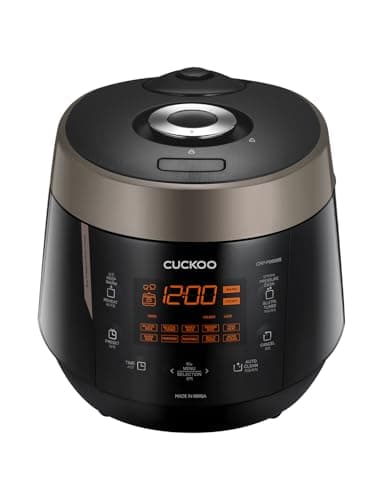
Cuckoo CRP-P0609S High-Pressure Rice Cooker, 6 Cup
A pressurized rice cooker, which is the Korean approach and a genuinely different one: cooking rice under pressure raises the boiling point and produces a distinctly fluffier, stickier grain, especially for short-grain and mixed rice. 890 W, a 304 stainless pot, and Cuckoo's signature talking interface.
680 W
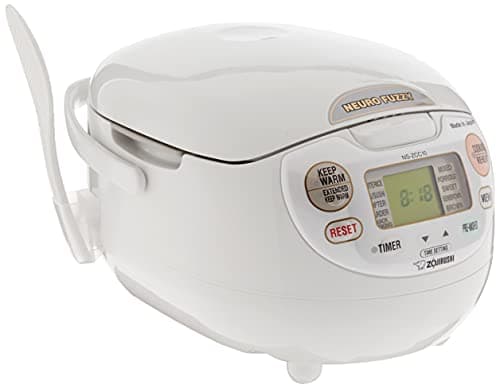
Zojirushi NS-ZCC10 Neuro Fuzzy Rice Cooker & Warmer, 5.5 Cup
The rice cooker every other one is measured against. Its Neuro Fuzzy microcomputer adjusts heat through the cook rather than running a fixed timer, which is the whole reason a $260 rice cooker cooks rice better than a $30 one. Made in Japan, 680 W, and the settings that matter are all there.
1,000 W
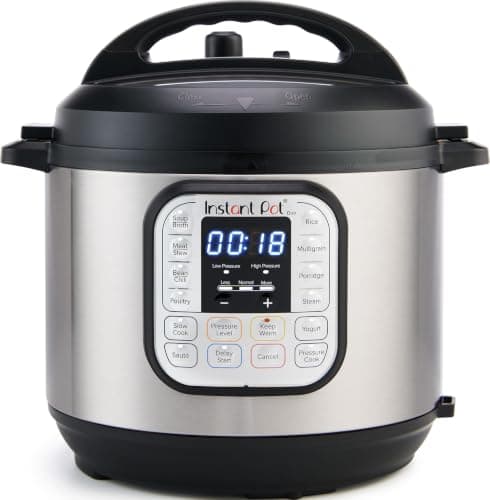
Instant Pot Duo 7-in-1 Electric Pressure Cooker, 6 Quart
The multicooker that made the category, and still the right default. Instant Brands publishes the wattage, the working pressure range and a stainless (not nonstick) inner pot, which is more than most of the field manages — and it costs less than almost all of them.
#ad · As an Amazon Associate we earn from qualifying purchases.
Questions
Frequently asked
Is there a rice cooker with a stainless steel inner pot?
What is the most non-toxic rice cooker?
What is the Zojirushi inner pot made of?
Is a ceramic rice cooker pot safer than nonstick?
Can you replace the inner pot of a rice cooker?
How do I stop the coating on my rice cooker wearing out?
Keep reading
Related
- The best non-toxic multicookerThe same question where the answer is better: uncoated stainless pots.
- How to clean a rice cookerWhat protects a coating, and what destroys it.
- Cuckoo CRP-P0609S reviewThe only cooker here with a documented stainless pot body.
- Are expensive rice cookers worth it?What the money buys — and it is not the pot.
- The best rice cookersThe field ranked on everything, not just the pot.
Receipts
Sources
- Cuckoo America — CRP-P0609S pressure rice cooker product page
- Cuckoo America — CR-0631F Micom rice cooker product page
- Aroma Housewares — ARC-994SG instruction manual [PDF]
- Zojirushi — NS-ZCC10 Neuro Fuzzy Rice Cooker product page
- Instant Brands — Instant Pot Duo 6qt product page
We have not tested these machines in a lab and we do not pretend to have. Specifications come from the manufacturer's own published documents; electricity rates come from the US Energy Information Administration; prices come from the live Amazon API. Where a figure is not published, the page says “not published” rather than guessing. Read the full method.