HUB 03
Sous Vide & Immersion Circulators
The most spec-driven category on the site, and the one where the numbers actually mean something. A circulator holds a water bath at a precise temperature — so wattage, published range and stated accuracy are the whole product. We rank on the figures the manufacturer prints, and note plainly where one prints nothing.
We earn a commission if you buy through our links. It does not change the price you pay, and it does not decide our picks — the scoring rubric is published in full, including what disqualifies a pick. How this works.
Start here
The Best Sous Vide Machines
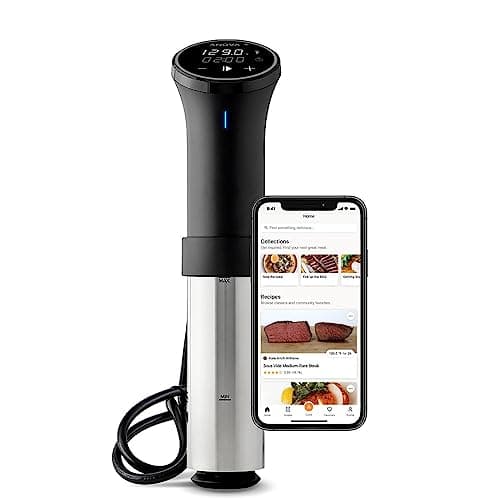
Our top pick: Anova Precision Cooker 3.0 (WiFi), 1100 W — The sous vide circulator most people should buy. Anova publishes the full specification — 1,100 W, a 0–92°C range, ±0.1°C accuracy, an 8 L/min pump — and backs it with a two-year warranty, the longest here. It has an on-device screen so it works without the app, which the Joule does not.
What a sous vide machine actually is
An immersion circulator is a heating element, a pump and a thermometer on a stick. You clip it to a pot of water, set a temperature, and it circulates the water to hold that temperature to a fraction of a degree for hours. Food sealed in a bag then cooks to exactly that temperature and cannot overcook — a steak set to 54°C comes out a perfect medium-rare edge to edge whether you pull it at one hour or three. That precision is the entire product, which is why the specs in this category actually mean something.
The three numbers that matter
Wattage decides how fast it heats a bath and how big a bath it can hold — 800 watts is plenty for a single steak in a small pot, 1,100 handles a large batch in a cooler. Temperature range and accuracy are the precision itself: the good machines publish ±0.1°C, which matters most for eggs and long, low cooks. And here the honest finding is a documentation one — Anova, Inkbird and Wancle publish the full specification, while Breville does not publish a temperature range or accuracy for the Joule anywhere we could find. For a device sold on precision, that silence is worth knowing about.
The split that decides your machine: screen or app
The biggest usability difference is whether the machine has an on-device screen. The Anova, Inkbird, Greater Goods and Wancle all have physical controls, so they work with a dead phone. The Breville Joule is app-only — no buttons, no screen. It is the smallest and cleverest device here, and if your phone is not part of every cook, it is also the one that will frustrate you. Decide that before you weigh anything else, because it is not a preference you can change later.
What it is good at, and what it is not
Sous vide is the most precise way to bring a protein to temperature: steak, chicken, eggs and tough cuts held for hours all come out exact. It is not fast, and it does not brown — browning needs heat well above boiling — so almost every sous vide steak gets a quick, hot sear afterward. It will not tenderize a cheap cut the way pressure cooking does, and it is the wrong tool for most vegetables. Think of it as one precise technique paired with a sear, not a replacement for the whole kitchen.
The running cost is smaller than it looks
A 1,100-watt circulator sounds power-hungry, but it only draws full power while heating the bath up — once at temperature it sips. A two-hour cook computes to about 41¢ at full draw and the US average of 18.83¢ per kWh, and that is an upper bound because the element cycles once the water is hot. A capable machine now starts under $100, which has lowered the bar to try sous vide about as far as it will go.
Everything in this section
All of Sous Vide
Roundup
The Best Sous Vide Machines
Six sous vide circulators ranked on wattage, published range and accuracy. The Anova 3.0 is the complete default; the Inkbird is the value shock under $100.
Top pick: Anova Precision Cooker 3.0 (WiFi), 1100 W · 6 ranked, 5 with live prices
$123.72on Amazon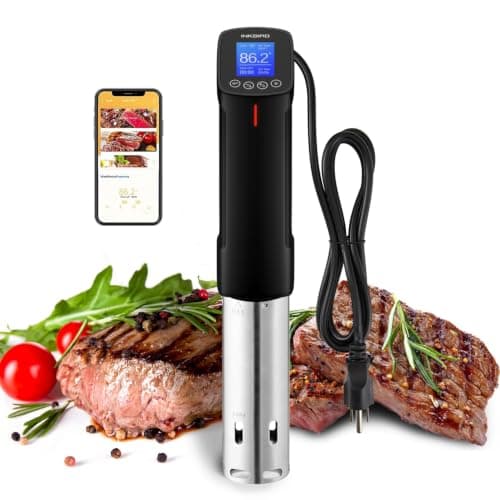
Roundup
The Best Value Immersion Circulators
The circulator field ranked on spec-per-dollar. The Inkbird publishes Anova-level accuracy and WiFi for under $100; the Anova still leads on warranty and polish.
Top pick: Inkbird ISV-100W WiFi Sous Vide, 1000 W · 6 ranked, 5 with live prices
$95.99on AmazonHead to head
Anova vs Breville Joule
Anova 3.0 vs Breville Joule Turbo: same 1,100 W, opposite philosophies. The Anova has an on-device screen and publishes its full spec; the Joule is smaller but app-only.
Top pick: Anova Precision Cooker 3.0 (WiFi), 1100 W · 2 ranked, 2 with live prices
$123.72on AmazonRoundup
The Best Budget Sous Vide Machines
Four sous vide circulators under about $100, ranked. The Inkbird publishes a full spec and matches pricier machines on paper; the Anova Nano buys into Anova's build and warranty; the Greater Goods runs silent; the 1,100 W Wancle is the cheapest way to try the technique at all.
Top pick: Inkbird ISV-100W WiFi Sous Vide, 1000 W · 4 ranked, 3 with live prices
$95.99on AmazonHead to head
Anova vs Inkbird
The default vs the value champion. The Inkbird matches the Anova on the numbers that cook — wattage, range, ±0.1°C accuracy — for under half the price. The Anova's premium buys warranty, refinement and a longer range.
Top pick: Anova Precision Cooker 3.0 (WiFi), 1100 W · 2 ranked, 2 with live prices
$123.72on AmazonReview
Anova Precision Cooker 3.0 Review
The category default, reviewed. A fully specified 1,100 W WiFi circulator with ±0.1°C accuracy, an on-device screen and a two-year warranty. What it does best, and when the Inkbird or Nano is the smarter buy.
Top pick: Anova Precision Cooker 3.0 (WiFi), 1100 W
$123.72on AmazonRoundup
The Best WiFi Sous Vide Machines
The connected circulators, ranked. The Anova leads because it has WiFi and a screen; the Inkbird gives you both for under $100; the Joule is the most app-forward but app-only. The screen-or-not distinction is the whole story.
Top pick: Anova Precision Cooker 3.0 (WiFi), 1100 W · 4 ranked, 3 with live prices
$123.72on Amazon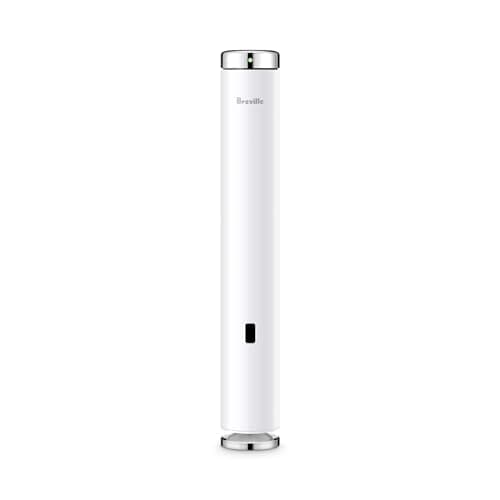
Review
Breville Joule Turbo Review
The app-only Joule Turbo, reviewed. The most compact circulator here, with a magnetic foot, IPX7 waterproofing and the best beginner app in the category — but no screen and no buttons, so a dead phone means a dead machine, and Breville publishes no temperature-range or accuracy figure.
Top pick: Breville Joule Turbo Sous Vide (BSV600), 1100 W
$227.25on AmazonReview
Inkbird ISV-100W Review
The sub-$100 Inkbird, reviewed. A 1,000 W circulator with a published 25–99°C range, ±0.1°C accuracy, WiFi and an on-device screen — it undercuts the Anova by more than half and gives up remarkably little on paper. The trades: a one-year warranty and a merely-functional app.
Top pick: Inkbird ISV-100W WiFi Sous Vide, 1000 W
$95.99on AmazonHead to head
Anova vs Greater Goods
The connected default versus the deliberately-offline circulator. The Anova brings WiFi, a full published spec and a two-year warranty; the Greater Goods brings a genuinely silent motor and no app to set up or fail. A rule for which suits you.
Top pick: Anova Precision Cooker 3.0 (WiFi), 1100 W · 2 ranked, 2 with live prices
$123.72on Amazon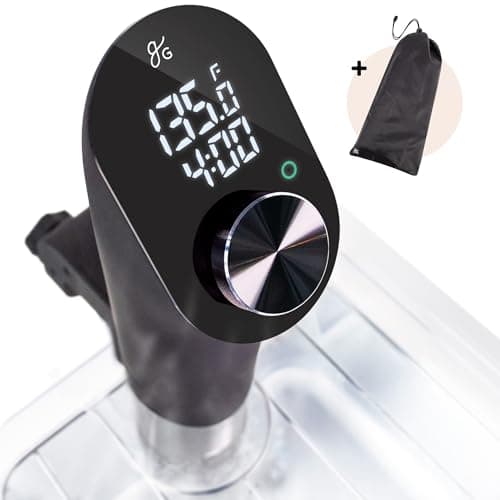
Review
Greater Goods Sous Vide Review
The no-app circulator, reviewed. A 1,100 W machine with a genuinely silent brushless motor rated for 99 hours of continuous running, a dial and a screen, and no connectivity by design. Quiet and simple, with a thinner spec sheet than the Anova or Inkbird.
Top pick: Greater Goods Sous Vide Precision Cooker, 1100 W
$89.99on AmazonHead to head
Greater Goods vs Inkbird
Two strong budget circulators, opposite philosophies. Inkbird: WiFi, a screen, a published ±0.1°C spec, a 25 to 99°C range. Greater Goods: a silent brushless motor, no app, no published accuracy. Connectivity and spec against quiet and simplicity.
Top pick: Inkbird ISV-100W WiFi Sous Vide, 1000 W · 2 ranked, 2 with live prices
$95.99on AmazonHead to head
Breville Joule vs Inkbird
The premium app-only Joule against the value WiFi-and-screen Inkbird. The Inkbird publishes a full spec (1,000 W, 25 to 99°C, ±0.1°C, 15 L) and works without a phone for under $100; the Joule is the smallest, nicest build with Turbo mode but is app-only and publishes no temperature range or accuracy. The Inkbird wins for most.
Top pick: Inkbird ISV-100W WiFi Sous Vide, 1000 W · 2 ranked, 2 with live prices
$95.99on AmazonHead to head
Anova vs Monoprice
The premium-default Anova Precision Cooker 3.0 against the floor-price Monoprice Strata. The Anova publishes a full spec (1,100 W, 0-92°C, ±0.1°C accuracy, 8 L/min pump), adds an on-device screen and dual-band WiFi, and carries a two-year warranty. The 800 W Monoprice quotes looser ±1% stability, has physical controls only, and publishes no warranty. Buy the Anova if you cook often; the Monoprice to try sous vide cheaply.
Top pick: Anova Precision Cooker 3.0 (WiFi), 1100 W · 2 ranked, 1 with live prices
$123.72on AmazonHead to head
Inkbird vs Monoprice
Two budget circulators. The Inkbird ISV-100W is fully specified under $100 (1,000 W, 25-99°C, ±0.1°C accuracy, 15 L, WiFi plus an on-device screen, one-year warranty). The 800 W Monoprice Strata is the cheapest here, with looser ±1% stability, physical controls only and no published warranty. The fork: spend a little more for WiFi and tighter control, or the least to try sous vide.
Top pick: Inkbird ISV-100W WiFi Sous Vide, 1000 W · 2 ranked, 1 with live prices
$95.99on AmazonRoundup
The Best Sous Vide Machines for Beginners
The best sous vide circulators for a first-time cook, ranked criteria-first: the Anova Precision Cooker 3.0 (a screen, a good app and the longest warranty), the Inkbird ISV-100W (a fully-specified screen-and-WiFi machine for under $100), the Breville Joule (the best beginner app, but app-only), and the Monoprice (the cheapest way to try the technique). Live prices on every card.
Top pick: Anova Precision Cooker 3.0 (WiFi), 1100 W · 4 ranked, 3 with live prices
$123.72on AmazonHead to head
Greater Goods vs Monoprice Sous Vide
Two no-WiFi, no-app circulators compared: the 1,100 W Greater Goods, with a silent brushless motor and a 99-hour run rating, against the 800 W Monoprice, the cheapest way into sous vide with a directional pump cap. Power, quietness, accuracy and price — and a clear rule for which offline machine is for you.
Top pick: Greater Goods Sous Vide Precision Cooker, 1100 W · 2 ranked, 1 with live prices
$89.99on AmazonHead to head
Breville Joule vs Greater Goods
The app-only Breville Joule against the no-connectivity Greater Goods, both 1,100 W. The Joule is the smallest body here with Turbo mode and the best beginner app, but it has no screen and cannot be run without a phone. The Greater Goods has a dial, a screen and a silent brushless motor rated for 99-hour cooks, but no app or WiFi. Opposite philosophies; which fits how you cook.
Top pick: Breville Joule Turbo Sous Vide (BSV600), 1100 W · 2 ranked, 2 with live prices
$227.25on AmazonHead to head
Breville Joule vs Monoprice
The premium, app-only Breville Joule against the floor-price Monoprice Strata. The Joule is the smallest, most polished circulator with a Turbo mode and the best beginner app, but it is phone-only. The Monoprice has physical controls, an 800 W element and looser +/-1% stability, at the lowest price here. What the extra money buys, and when the budget pick is smarter.
Top pick: Breville Joule Turbo Sous Vide (BSV600), 1100 W · 2 ranked, 1 with live prices
$227.25on Amazon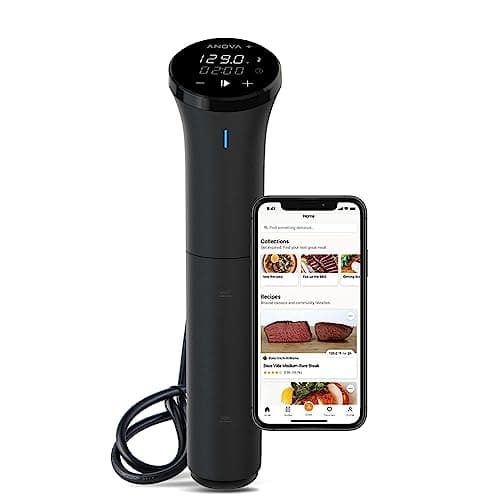
Review
Anova Precision Cooker Nano Review
The cheapest way into Anova, reviewed. An 850 W circulator in a slim body, now with WiFi where the old Nano was Bluetooth-only — and the same ±0.1°C accuracy, app and two-year warranty as the full model. Plenty for a single steak or a couple of portions; the lower power only shows when you heat a big, deep bath. Its one quirk: no live price at our last check.
Top pick: Anova Precision Cooker Nano 3.0 (WiFi), 850 W
Check price on Amazon →Head to head
Anova Precision Cooker vs Nano
Same accuracy, same range, same two-year warranty — the two Anovas differ on power (1,100 W vs 850) and size. The full Precision Cooker 3.0 heats a large, deep bath faster and circulates more water; the slimmer Nano is cheaper and enough for everyday portions. What the extra power buys, and when it doesn't.
Top pick: Anova Precision Cooker 3.0 (WiFi), 1100 W · 2 ranked, 1 with live prices
$123.72on AmazonRoundup
The best sous vide for steak
Ranked for beef, not in general. The Anova Precision Cooker 3.0 publishes the full specification — 1,100 W, ±0.1 °C, an 8 L/min pump — and has an on-device screen, which is the pick for steak. The Inkbird matches the accuracy figure for far less, the Joule is the smallest if you live in the app, and the Wancle is the floor.
Top pick: Anova Precision Cooker 3.0 (WiFi), 1100 W · 5 ranked, 5 with live prices
$123.72on Amazon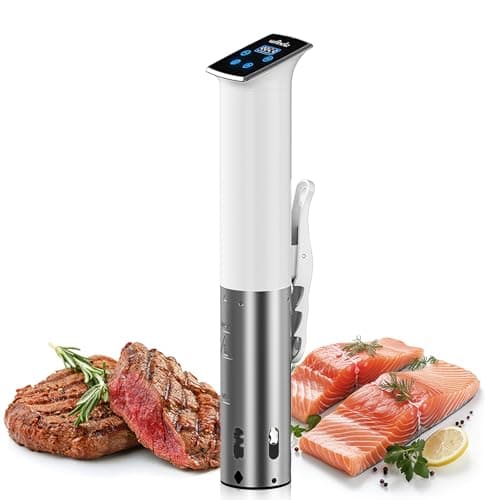
Review
Wancle Sous Vide Review
1,100 W, a published 25-90 C (77-194 F) range, IPX7 so the body rinses under the tap, a 1-minute-to-99-hour timer and a 20 L maximum bath - all on Wancle's own spec page. The accuracy claim is the manufacturer's own with no third-party check behind it, and Wancle publishes no warranty term anywhere.
Top pick: Wancle 1100 W Sous Vide Immersion Circulator (820)
$41.99on AmazonRoundup
The Best Sous Vide Machines for Yogurt
Ranked on the four specs that decide an eight-hour incubation: published temperature range, stated accuracy, timer length and rated bath volume. Anova's Precision Cooker 3.0 takes it on a 0-92C range, a 2-year warranty and an 8 L/min pump; the Inkbird is the value pick with a published 15 L bath; the Wancle is the only one publishing a 99-hour timer.
Top pick: Anova Precision Cooker 3.0 (WiFi), 1100 W · 3 ranked, 2 with live prices
$123.72on AmazonGuide
What Is Sous Vide?
Cooking sealed food in a precisely heated water bath so it can't overcook. The mechanism, what it's good at (and not), and the gear to do it.
Covered here: Anova Precision Cooker 3.0 (WiFi), 1100 W
$123.72on AmazonGuide
Is Sous Vide Worth It?
Yes if you cook the things it is uniquely good at — edge-to-edge steak, precise chicken, eggs, tough cuts made tender. No if you want fast weeknight dinners or a crispy finish without extra steps. The honest split.
Covered here: Anova Precision Cooker 3.0 (WiFi), 1100 W
$123.72on AmazonData
Sous Vide Temperature Guide
The doneness temperatures cooks commonly use for steak, chicken, pork, fish and eggs — plus how time and temperature together keep food safe, with USDA guidance cited. A reference for any circulator.
Covered here: Anova Precision Cooker 3.0 (WiFi), 1100 W
$123.72on AmazonGuide
How to Sous Vide a Steak
The full method for a sous vide steak: choose a doneness temperature, season and bag, hold it in the bath for one to four hours, then finish with a hard, fast sear. Why it gives edge-to-edge doneness, plus the food-safety note on time and temperature.
Covered here: Anova Precision Cooker 3.0 (WiFi), 1100 W
$123.72on AmazonGuide
Sous Vide Without a Vacuum Sealer
You do not need a vacuum sealer to start sous vide. The water-displacement method with a zip-top bag gets the air out reliably — the full technique, which bags to use, and the handful of cases (long cooks, freezing, batch prep) where a sealer earns its place.
Covered here: Inkbird ISV-100W WiFi Sous Vide, 1000 W
$95.99on AmazonGuide
Is Sous Vide Safe?
Sous vide is safe when you follow time and temperature together: holding food at a precise lower temperature long enough pasteurizes it, which the USDA recognizes. How the danger zone works, why you cannot judge safety by final temperature alone, and whether the plastic bags are safe.
Covered here: Anova Precision Cooker 3.0 (WiFi), 1100 W
$123.72on AmazonGuide
How Long to Sous Vide Chicken
Tender chicken breast lands around 145 to 150°F; fall-apart thighs higher or held longer. The key is that time and temperature together make poultry safe, so you can cook below 165°F if you hold it long enough — the USDA's pasteurization logic. Times by thickness, plus the sear.
Covered here: Anova Precision Cooker 3.0 (WiFi), 1100 W
$123.72on AmazonGuide
How to Sous Vide Eggs
Eggs are the classic sous-vide showcase because temperature alone sets the texture, from a custardy onsen egg to a firmly set one. No bag needed — cook them in the shell. Commonly-used temperature ranges here, with the exact chart deferred to the temperature guide, plus why ±0.1°C control matters more for eggs than for steak, and the USDA safety line.
Covered here: Anova Precision Cooker 3.0 (WiFi), 1100 W
$123.72on AmazonGuide
How to Sous Vide Salmon
Silky, evenly cooked salmon with almost none of the white albumin a hot pan forces out. Bag it gently with a little oil, pick a doneness (commonly silky medium-rare up to a firmer flake — full chart in the temperature guide), cook 30 to 45 minutes, then sear the skin. Includes the USDA safety line: 145°F is the safe minimum for fish, and below that you rely on time-and-temperature pasteurization and fresh handling.
Covered here: Anova Precision Cooker 3.0 (WiFi), 1100 W
$123.72on AmazonGuide
What Can You Cook Sous Vide?
A survey of what sous vide is genuinely great at — steak and tender proteins edge-to-edge, tough cuts turned tender over long low cooks, chicken, eggs, fish, pork, vegetables at a higher temperature (~183°F+), and even custards, yogurt and infusions — and what it is not good for: crisp textures without a finishing sear, quick weeknight cooking, and breads.
Covered here: Anova Precision Cooker 3.0 (WiFi), 1100 W
$123.72on AmazonGuide
Is Sous Vide Healthy?
The honest health angle on sous vide: it uses no added fat, retains water-soluble nutrients that boiling washes away, cooks gently, and pasteurizes food safely. The two real questions people ask — is cooking in plastic safe (yes, with food-grade bags well below boiling) and does it make food healthier (no, it can't fix the ingredient) — answered straight, with USDA framing on safety.
Covered here: Anova Precision Cooker 3.0 (WiFi), 1100 W
$123.72on AmazonGuide
How to Choose a Sous Vide Machine
A plain-English buyer's guide to what separates one circulator from another: temperature accuracy (±0.1°C vs ±1% and when it matters), wattage and pump flow, an on-device screen versus app-only, WiFi or none, whether the brand publishes a full spec at all, size and clamp versus magnetic foot, warranty, and the price tiers from the Monoprice floor to the Inkbird value, Anova default and Joule premium.
Covered here: Anova Precision Cooker 3.0 (WiFi), 1100 W
$123.72on AmazonGuide
How to Sous Vide Pork Chops
The reliable way to a juicy pork chop: season, seal with the water-displacement method, hold at one exact temperature, then a hot hard sear. Exact temperatures and times are deferred to the temperature guide. On safety, the USDA safe minimum for pork is 145°F with a three-minute rest — and if you cook lower for juiciness, safety comes from holding long enough to pasteurize, a function of both time and temperature.
Covered here: Anova Precision Cooker 3.0 (WiFi), 1100 W
$123.72on AmazonGuide
How to Sous Vide Vegetables
Vegetables need a higher bath than meat — roughly the mid-180s°F (mid-80s°C) — because plant cell walls of pectin and cellulose only soften near the boil, so you can't cook veg and a rare steak together. Firm vegetables like carrots and potatoes are the best candidates; season and add fat right in the bag, cook in a single layer, and weigh the bag down so nothing floats. Exact temperatures deferred to the temperature guide.
Covered here: Inkbird ISV-100W WiFi Sous Vide, 1000 W
$95.99on AmazonGuide
Can You Sous Vide Frozen Meat?
Yes, and it's one of the best ways to cook from frozen: the low, precise bath thaws and cooks in one gentle motion with no overcooked outer layer. Keep the same target temperature, add roughly an extra hour, separate any stuck-together pieces so the water flows, and make sure the whole piece reaches a pasteurizing time and temperature. Unlike a slow cooker, which is unsafe from frozen because it heats too slowly.
Covered here: Anova Precision Cooker 3.0 (WiFi), 1100 W
$123.72on AmazonGuide
Sous Vide vs Grilling
A technique comparison. Sous vide gives exact edge-to-edge doneness, hands-off and impossible to overcook, but no char or crust on its own and it is slow. Grilling is fast and delivers smoke and a Maillard crust, but leaves a doneness gradient and is easy to overshoot. The best-of-both is sous vide first, then a hard sear on the grill to finish — plus when to pick each on its own.
Covered here: Anova Precision Cooker 3.0 (WiFi), 1100 W
$123.72on AmazonGuide
Do You Sear Before or After Sous Vide?
Sear after the bath, almost every time. Why searing after gives you a fresh, crisp crust on food that's cooked perfectly edge-to-edge, why a pre-sear mostly just adds a step, the one case where a quick pre-sear helps, and how to get the best possible crust after sous vide without overcooking the inside.
Covered here: Anova Precision Cooker 3.0 (WiFi), 1100 W
$123.72on AmazonGuide
Can You Use Ziploc Bags for Sous Vide?
For most everyday sous vide, yes — a good freezer-grade zip-top bag works. Why typical sous vide temperatures sit well below boiling, how to use freezer-grade food-safe bags and the water-displacement method to remove air, and the few longer, hotter cooks where a vacuum-sealed or purpose-made bag is the better choice.
Covered here: Anova Precision Cooker 3.0 (WiFi), 1100 W
$123.72on AmazonGuide
How to Keep a Sous Vide Bag From Floating
A floating sous vide bag cooks unevenly, because the exposed part sits out of the temperature-controlled water. The cause is almost always trapped air — so remove it with the water-displacement method first — plus the reliable ways to hold a bag under: weigh it down, clip it to the side, use a rack, and keep the whole bag submerged.
Covered here: Inkbird ISV-100W WiFi Sous Vide, 1000 W
$95.99on AmazonGuide
What Container to Use for Sous Vide
You can start sous vide in a stockpot you already own — here's how to pick the right size and depth. Why a dedicated polycarbonate tub with a lid is the upgrade for long or big cooks (less evaporation, more capacity, a place to clip the circulator), plus how a lid, insulation and check-clip fit affect the setup.
Covered here: Anova Precision Cooker 3.0 (WiFi), 1100 W
$123.72on AmazonGuide
How to Sous Vide Brisket
Sous vide brisket takes a very long, hands-off bath: a lower temperature over 36 to 48 hours gives a sliceable, steak-like texture, while a higher temperature over about 24 to 36 hours gives the traditional pull-apart result. Either way you finish with bark from a smoker, grill or oven. The two approaches, the timing, and the food-safety rules a long cook demands.
Covered here: Anova Precision Cooker 3.0 (WiFi), 1100 W
$123.72on AmazonGuide
How to Sous Vide Ribs
Sous vide ribs let you dial the exact tenderness by temperature: a higher bath gives fall-off-the-bone, a lower one a meatier bite that still tugs cleanly off the bone. Both need a long cook (often 12 to 36 hours), then a fast finish with sauce under the broiler or on the grill for the caramelized crust. The method, timing and the safety line.
Covered here: Anova Precision Cooker 3.0 (WiFi), 1100 W
$123.72on AmazonGuide
How to Sous Vide Shrimp
Shrimp overcook in seconds on a stove, so the gentle, exact temperature of a sous vide bath is a natural fit: they come out tender and snappy, never rubbery, with no window to overshoot. It is a quick cook, usually well under an hour. The timing, why the low temperature is the whole point, and an optional fast sear for color.
Covered here: Anova Precision Cooker 3.0 (WiFi), 1100 W
$123.72on AmazonGuide
How to Sous Vide Turkey Breast
Lean turkey breast dries out easily in the oven; sous vide keeps it juicy by holding it at one exact temperature edge to edge, then you crisp the skin separately under high heat. It is an excellent make-ahead for a holiday, freeing the oven. The method, timing, and the food-safety point about pasteurizing poultry by time and temperature.
Covered here: Anova Precision Cooker 3.0 (WiFi), 1100 W
$123.72on AmazonGuide
How to Clean a Sous Vide Machine
A sous vide circulator stays clean because it only sits in clean water, but the heating element and pump collect mineral scale over time, especially in hard-water areas. The routine is simple: wipe the body, clean the removable skirt and impeller, and periodically run a vinegar-and-water bath to descale. How to do each step, and how often.
Covered here: Anova Precision Cooker 3.0 (WiFi), 1100 W
$123.72on AmazonGuide
How to Sous Vide Pork Tenderloin
The fix for a cut that dries out in a heartbeat: hold the whole tenderloin at one exact temperature for even, juicy doneness, then a fast, hot sear for crust. Season, seal with the water-displacement method, and defer exact temperatures to the temperature guide. On safety, the USDA minimum for pork is 145°F with a rest — or cook lower and hold long enough to pasteurize.
Covered here: Anova Precision Cooker 3.0 (WiFi), 1100 W
$123.72on AmazonGuide
How to Sous Vide Burgers
An evenly cooked, juicy burger to your exact doneness, then a hard, fast sear for crust — no gray band. The method mirrors any sous vide protein, but ground beef carries a stricter safety rule than steak: the USDA minimum is 160°F, and cooking lower is only safe if you hold long enough at temperature to pasteurize. Exact numbers are deferred to the temperature guide.
Covered here: Anova Precision Cooker 3.0 (WiFi), 1100 W
$123.72on AmazonGuide
How to Sous Vide Lamb Chops
A precise, edge-to-edge cook on a cut that is expensive to ruin: hold the chops at one exact temperature for even doneness, then a hard, fast sear to crisp the fat and brown the outside. Season, seal, and defer exact temperatures to the temperature guide. On safety, the USDA minimum for whole-cut lamb is 145°F with a rest, or pasteurize by holding at temperature.
Covered here: Anova Precision Cooker 3.0 (WiFi), 1100 W
$123.72on AmazonGuide
Can You Overcook Sous Vide?
Sous vide can't overshoot your set temperature, so it is far more forgiving than a pan — but you can still overcook by time. Hold a steak many hours past its window and it turns mushy; hold fish or eggs and they go mealy fast. What temperature controls (doneness) versus what time controls (texture), and the safe windows for each food.
Covered here: Anova Precision Cooker 3.0 (WiFi), 1100 W
$123.72on AmazonGuide
How to Sous Vide Tri-Tip
Sous vide is a great fix for tri-tip's two problems - it tapers so it cooks unevenly, and it is lean enough to dry out. Cook it at 131-135F for a medium-rare roast that is edge-to-edge even, hold it 6-8 hours to tenderize the coarse grain, then sear hard and slice against the grain. The temperature chart, the timing, and why the long hold matters.
Covered here: Anova Precision Cooker 3.0 (WiFi), 1100 W
$123.72on AmazonGuide
How to Sous Vide a Chuck Roast
A chuck roast is tough and cheap, and sous vide offers two routes. The low road - 131-135F for 24 to 48 hours - keeps it a rosy medium-rare but breaks down the connective tissue into a tender, sliceable 'roast.' The high road - 165-175F for 8 to 24 hours - melts the collagen into classic fall-apart pot roast. The two schools, their times, and how to pick.
Covered here: Anova Precision Cooker 3.0 (WiFi), 1100 W
$123.72on AmazonGuide
Can You Sous Vide Overnight?
Yes - you can leave a sous vide running overnight or for a day or two, and long unattended cooks are one of its main advantages. It is safe as long as the bath stays above about 130F, where food pasteurizes rather than spoils. The two things to manage are water evaporation (cover the bath) and never using a low temperature for a long cook.
Covered here: Anova Precision Cooker 3.0 (WiFi), 1100 W
$123.72on Amazon
Guide
How to Sous Vide Without a Machine
You can sous vide without a machine using a beer cooler of pre-heated water (which holds heat for an hour or two) or a pot babysat on the stove with a thermometer. It works for short, forgiving cooks like a steak, but it cannot hold temperature for the long, low cooks that make sous vide special - which is where an inexpensive circulator earns its keep.
Covered here: Anova Precision Cooker 3.0 (WiFi), 1100 W
$123.72on AmazonGuide
Sous vide vs reverse sear
Two versions of low-then-hot. Sous vide holds the exact final temperature in water and will wait for you; reverse sear uses a low oven and a probe and gives a drier surface that crusts better. Which wins depends on thickness, timing and whether you own a circulator.
Covered here: Anova Precision Cooker 3.0 (WiFi), 1100 W
$123.72on AmazonGuide
Immersion circulator vs sous vide
Sous vide is the method - sealed food in water held at the final serving temperature. An immersion circulator is the stick-shaped device that heats and pumps that water, and it is one of three ways to do the method. Which specs matter, what the alternatives give up, and when a water oven makes more sense.
Covered here: Anova Precision Cooker 3.0 (WiFi), 1100 W
$123.72on AmazonGuide
How Much Electricity Does a Sous Vide Use?
Every published circulator wattage we can cite - 850 W to 1,100 W - converted to cents per hour at the EIA's US average residential rate, with the ceilings for a one-hour steak, a four-hour chicken and a 48-hour brisket. Computed at full rated draw and labelled a maximum, because the element idles once the bath is up to temperature.
Covered here: Anova Precision Cooker 3.0 (WiFi), 1100 W
$123.72on AmazonGuide
Sous Vide vs Boiling
The mechanism, plainly: boiling water is 212F / 100C and a medium-rare steak is 130F, so boiling is a race the food loses. Sous vide sets the bath to the finish temperature instead - and most circulators cannot even reach boiling, which is the clearest proof the two methods are not variations on each other.
Covered here: Anova Precision Cooker 3.0 (WiFi), 1100 W
$123.72on Amazon
Filed elsewhere, written for you
Also worth reading
These live under a different section of the site but answer the same question a sous vide buyer is actually asking.
Buying Guides
Which Countertop Cooker Do You Need?
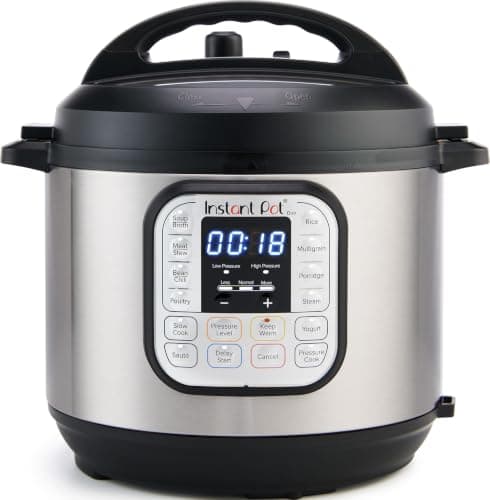
The short decision guide: what a multicooker, rice cooker and sous vide machine are each best at, and which to buy first for how you cook.
Covered here: Instant Pot Duo 7-in-1 Electric Pressure Cooker, 6 Quart
$71.89on AmazonBuying Guides
The Best Gifts for Steak Lovers
Five sous vide circulators as gifts for a steak lover, from our rankings: the Anova Precision Cooker 3.0 as the default (full published spec, touchscreen, two-year warranty), the compact app-only Breville Joule Turbo for the phone-native cook, the fully-specified Inkbird ISV-100W on a budget, the silent no-app Greater Goods for anyone who dislikes pairing appliances, and the Wancle as the cheapest try-it gift.
Top pick: Anova Precision Cooker 3.0 (WiFi), 1100 W · 5 ranked, 5 with live prices
$123.72on AmazonBuying Guides
Black Friday & Cyber Monday Kitchen Cooker Deals 2026: Multicookers, Rice Cookers & Sous Vide
The evergreen Black Friday and Cyber Monday hub for the cookers we rank: what has historically discounted (Instant Pot and Anova, reliably; Zojirushi, irregularly and not always at its lowest) and what has no public record, buy-now vs wait guidance by product class, and our current category winners with live prices. Verified deals are posted here when they go live in November 2026.
Top pick: Instant Pot Duo 7-in-1 Electric Pressure Cooker, 6 Quart · 8 ranked, 8 with live prices
$71.89on Amazon