HUB 02 · Rice Cookers
How to Cook Oatmeal in a Rice Cooker
A rice cooker makes a hands-off pot of oatmeal or porridge while you get ready in the morning, and many fuzzy-logic cookers have a Porridge setting built for exactly this. The one thing to manage is boil-over, since oats foam. Here are the ratios for rolled and steel-cut oats and how to keep it in the bowl.
We earn a commission if you buy through our links. It does not change the price you pay, and it does not decide our picks — the scoring rubric is published in full, including what disqualifies a pick. How this works.
Why oatmeal suits a rice cooker
Oatmeal is just a grain simmered in liquid until it softens, which is exactly what a rice cooker is built to do — and because it is hands-off, you can start it and walk away to get ready. Many fuzzy-logic cookers even have a dedicated Porridge setting tuned for cereals and congee, which is one of the quietly useful jobs in what a rice cooker can cook beyond rice. A cooker that keeps it warm afterward means breakfast is ready whenever the household is.
The ratios: rolled vs steel-cut
The oat type sets the water and time. Rolled (old-fashioned) oats want roughly 1 part oats to 2 parts waterand cook quickly — often within a standard cycle. Steel-cut oats are denser and need more liquid and longer, roughly 1 part oats to 3–4 parts water; the Porridge setting suits them if you have it, or a standard cook cycle followed by a rest. Use milk for part of the liquid if you want it creamier, and add a pinch of salt. Fruit and sweeteners are best stirred in at the end.
Keeping it from boiling over
Oats foamas they cook, and that foam is the reason a rice cooker can boil over with porridge — the same mechanism behind a rice cooker boiling over with starchy rice. Three things help: do not overfill (oats plus liquid expand a lot, so stay well under the max line), add a small pat of butter or a drop of oil to knock the foam down, and use the Porridge setting if your cooker has one, since it is programmed for a gentler simmer. Give it a stir at the end to smooth the texture, and let it sit a few minutes to thicken.
The hardware
The cookers this page is about
The cookers referred to above, with prices pulled live from Amazon and dated on every card. Full rankings live in the roundups linked from this page.
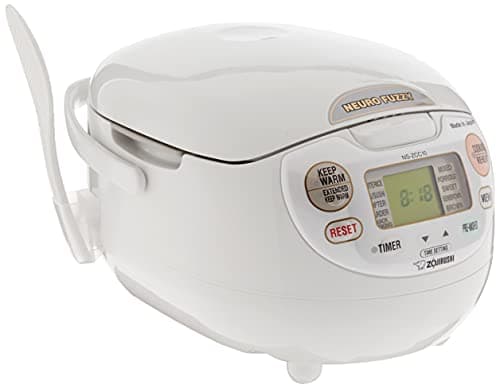
680 W
Zojirushi NS-ZCC10 Neuro Fuzzy Rice Cooker & Warmer, 5.5 Cup
The rice cooker every other one is measured against. Its Neuro Fuzzy microcomputer adjusts heat through the cook rather than running a fixed timer, which is the whole reason a $260 rice cooker cooks rice better than a $30 one. Made in Japan, 680 W, and the settings that matter are all there.
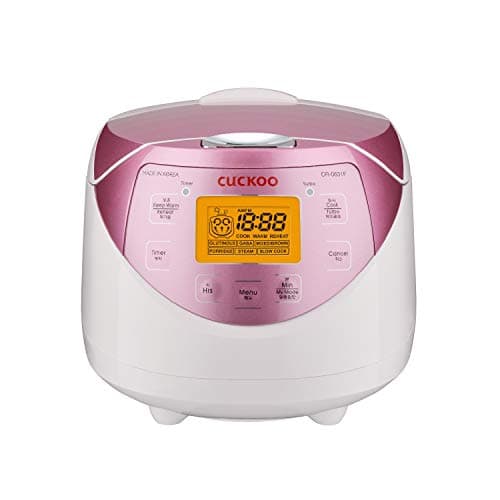
580 W
Cuckoo CR-0631F Micom Rice Cooker, 6 Cup
Cuckoo's non-pressure Micom cooker: the same Korean build and fuzzy-logic control as the CRP, without the pressure mechanism or its price. 580 W, a 6-cup nonstick pot, and a menu set that still covers GABA and brown rice. The sensible Cuckoo if you do not need pressure.
#ad · As an Amazon Associate we earn from qualifying purchases.
Questions
Frequently asked
What is the oats-to-water ratio for a rice cooker?
Why does oatmeal boil over in a rice cooker?
Can you make steel-cut oats in a rice cooker?
Keep reading